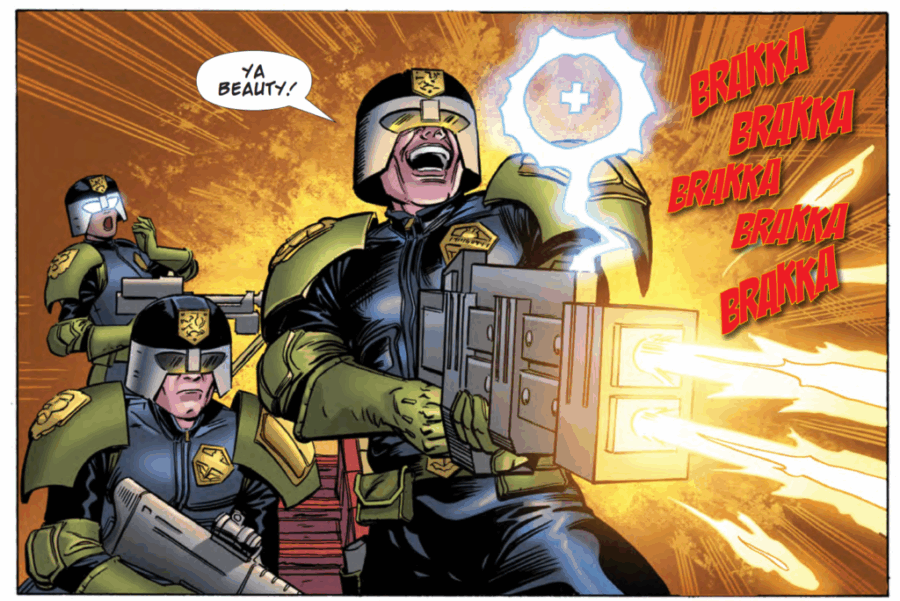
INTRODUCTION: A Scottish Creative Powerhouse Hey folks! Welcome to another BGCP creator interview. We are lucky enough to be chatting today with Gordon Rennie. Gordon Rennie is an incredibly talented writer from Scotland. He has worked in the comic book and videogame industries for the last 30 years. His impressive credits include: You can find multiple other cool titles of his over on Amazon. Let’s dive into the interview! INTERVIEW: The Early Days of a Pro Writer BGCP: Hi Gordon, thank you for speaking with us. Would you mind starting with your background and career? Gordon Rennie: My education? I got a useless arts degree from a Scottish redbrick university in the late 80s. It guaranteed to get me nowhere at the time. I started doing interviews and reviews for the UK comics press. Back then, they paid actual money for that. Most frustrated writers end up doing that. Warren Ellis started out at the same time for the same people. One magazine was Speakeasy. It morphed into Blast comic during the early 90s surge of ‘mature’ comics like Crisis and Revolver. I pitched some comic strip ideas to the editor. He bought just about everything I offered him. That was it. I was a professional comics writer. It seemed much easier in those days. BGCP: You began your career with Sewer Patrol in 1991. How did that first gig come about? What did you learn from it? Gordon Rennie: It was the first thing in print, but not the first professional thing I wrote. By then, I had written the first chapters of White Trash and Sherlock Holmes. Both appeared in the last issue of Blast before Tundra picked them up. Trust me, those were much better stories than Sewer Patrol. That was just a dumb and disposable Future Shock thing. However, Sewer Patrol taught me one notable lesson: I didn’t get paid. The people in charge sent me three post-dated cheques. All of them bounced. I learned early on not to work for spivs. SUCCESS AT 2000 AD: The Birth of Missionary Man BGCP: A few years later, you scored a gig writing for 2000 AD with Missionary Man. How did that happen? Gordon Rennie: Well, it was the Judge Dredd Megazine, not 2000 AD. At that time, I was still blacklisted from 2000 AD. I had written too many mean reviews of it. I sometimes think editor David Bishop hired me mainly to spite his colleagues. I pitched David a few things. He rejected most in his famously blunt style. However, he liked Missionary Man. It was an apocalyptic western set in the Cursed Earth. My main stroke of luck was David giving it to Frank Quitely. It was his first mainstream work. Those first stories aren’t very good, but they keep getting reprinted due to Quitely’s artwork. BGCP: You worked with 2000 AD for many years. How was your experience with them as a company? Gordon Rennie: Great. They pay regularly and on time. After my early experience with bounced cheques, that is the main thing. I get to do fun stories in the comic I grew up reading. We still laugh about the time they told me I’d never work for Tharg. WORKING WITH LEGENDARY IPs: Star Wars and Warhammer BGCP: You have written for many licensed properties. How does that affect your creative control? Gordon Rennie: It depends on the IP and the holder. Some holders just want the license money. They don’t care what you do. Others have very definite ideas on what you can and can’t do. Games Workshop is possessive with Warhammer. However, Lucasfilm is the most ferocious. I worked on a Star Wars game. Lucasfilm looked at everything I was doing. They liked my work, though. They even told the developer to bring me back for extra dialogue work. BGCP: Do you have a favorite IP that you enjoyed working with the most? Gordon Rennie: Judge Dredd, Doctor Who, and Star Wars. They were the holy trinity of my youth. Trust me, you haven’t lived until you see your name scroll up the screen on a Star Wars project with John Williams’ music playing. TRANSITIONING TO VIDEOGAMES: Killzone and Beyond BGCP: You wrote the script for the first Killzone game. What is your background with gaming? Gordon Rennie: I had been playing games since the Sega Mega-Drive days. I knew the tropes well. However, the jump to making them is a big one. It was a real eye-opener to see the complex business of making a game. My favorites are Tomb Raider and GTA. Generally, I like games where you blow stuff up. BGCP: Why did you move into videogames? Gordon Rennie: The Killzone guys came looking for me. They were fans of my Rogue Trooper work. Basically, I got an email asking me to come to Amsterdam for a meeting. The Killzone project finished without me. It was the first game I worked on and the first I was fired from. But it taught me how to make a game. Gaming paid much better than comics. I’ve worked on about 40 games over the last twenty years. I’ve done everything from laying down the basic story to polishing dialogue on Korean RPGs. DEVELOPMENT CHALLENGES: The Good, The Okay, and The Ugly BGCP: How does someone land a gig for a Sony exclusive IP? Gordon Rennie: I got my first games work because of my comic experience. These days, dedicated games writers begin directly in the industry. I’m afraid I have no idea how they do that now. BGCP: Does the story change based on the script, or are aspects already established? Gordon Rennie: It varies. In the early days, writers were an afterthought. Designers built the game and then brought in a writer to make sense of it. It was like putting up wallpaper after the house was built. Thankfully, that is rare now. Developers want writers early for world-building and plot ideas. BGCP: You also wrote for